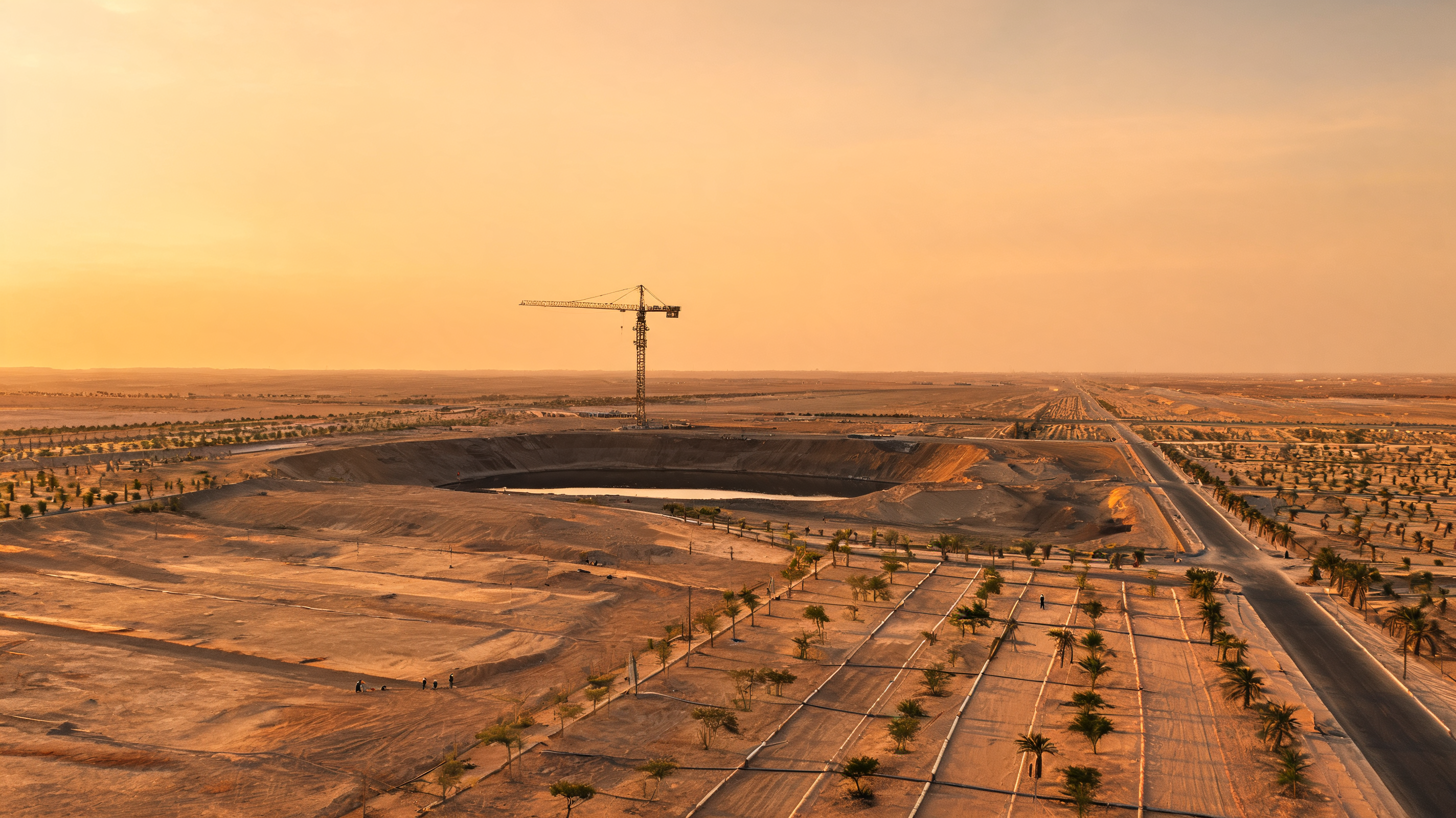
The most consequential decisions on a project like this are buried, literally. Long before a single villa appears, the water lines, the drainage, the planting corridors and the roads are going into the ground, and the care taken with them will quietly govern how the whole place ages.
01
Landscape as infrastructure
At Arabian Hills the green network is treated as a utility, not a finishing touch. Planting, water management and movement corridors were planned as one connected system so that shade, drainage and walkability reinforce each other instead of competing. Peter Vogt, the civil engineer overseeing the early works, has little patience for the alternative.
"On too many projects the landscape is the last line item and the first thing cut," he said, standing over a trench of freshly laid pipe. "Then everyone wonders why the streets bake and the water pools after the one big storm a year. We are doing it in the opposite order. The boring parts first."
“The landscape is usually the last line item and the first thing cut. We are doing it in the opposite order.”
02
Sequencing for the long game
Phasing a development this large is partly a logistical problem and partly a promise to early residents. The team has chosen to lay in the systems that future neighbourhoods will depend on ahead of the housing, so that the first arrivals inherit working parks and roads rather than a construction site with a view.
Vogt is careful not to oversell it. "Infrastructure is not exciting and it photographs badly," he said. "But it is the part you cannot fix later without tearing everything up. Get it wrong now and you are apologising for it for twenty years." It is a modest pitch. It is also, on a project measured in decades, probably the most important one.
03
Water is the whole argument
In this climate every green decision eventually becomes a water decision. Vogt's team has built the network around reuse rather than constant draw, routing treated water back into irrigation and choosing planting that can survive on far less than an imported garden would demand. The species list leans on plants adapted to arid ground, so that the landscape reads as lush without pretending it sits in a temperate country.
"The mistake is to plant a European park in a desert and then spend forty years fighting the climate to keep it alive," Vogt said. "That is not landscaping, it is life support. We would rather work with what actually grows here and design the water system so the green pays for itself over time." He points to the corridors of hardier planting threading between neighbourhoods as the real backbone, shade and habitat that will only look better as it matures, rather than a showpiece lawn that peaks on handover day and declines from there.
“Planting a European park in a desert is not landscaping, it is life support.”
04
Building trust you cannot see
There is a human dimension to all this buried work, and Vogt is aware of it. Early residents of any large development are, in a sense, extending credit, paying for a promise that the missing pieces will arrive. Front-loading the unglamorous systems is how the team hopes to honour that. "The first families here are trusting us with years of their lives," he said. "The least we can do is make sure the taps work and the streets drain before we ask them to admire the architecture."
By Layla Haddad, for the Arabian Hills Journal.