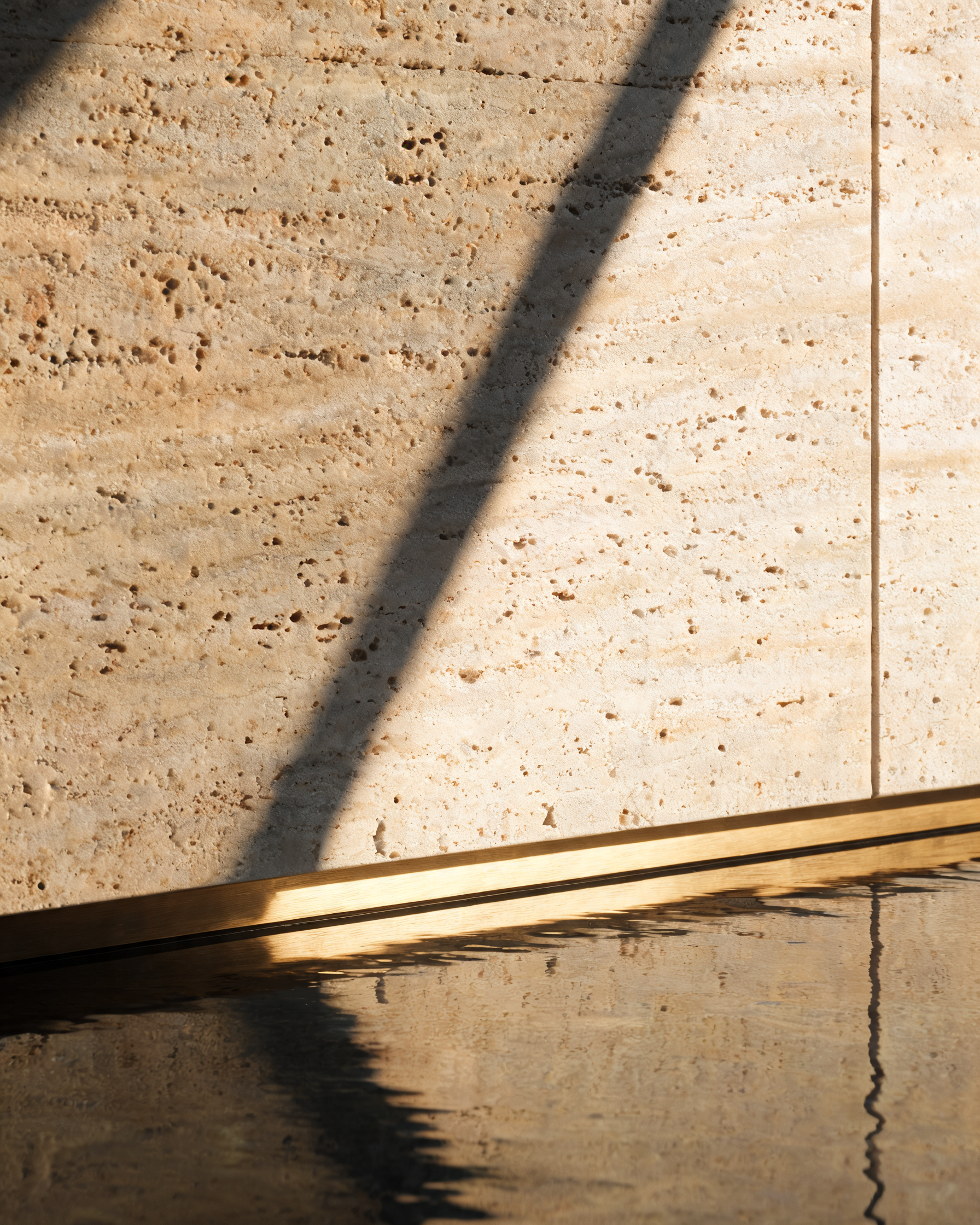
You feel a building before you analyse it, and usually you feel it at the scale of the hand: the weight of a door handle, a shadow line where two materials meet, the way a wall turns a corner. Get those wrong and no amount of square footage will save the impression.
01
Precision you are not meant to notice
The detailing at Arabian Hills is resolved to feel inevitable rather than decorative. Junctions are clean, the meeting of stone and metal is deliberate, and proportions are tuned until they stop drawing attention to themselves. Tomás Iriarte, who works across the residential detailing, argues that this is where budgets quietly reveal a project's real priorities.
"Anyone can spend money on a dramatic lobby," he said. "The test is the reveal around a window, the thing nobody photographs. If that is right, the whole house feels calm and you cannot say why. If it is wrong, the house feels cheap and you also cannot say why. The eye knows before the brain does."
“The test is the reveal around a window, the thing nobody photographs. The eye knows before the brain does.”
02
Built to age, not to impress
Durability and beauty are treated as the same problem here. Surfaces are chosen not for how they look on handover day but for how they will wear through years of sun, dust and use. A material that patinas well is preferred to one that only shines when new, because a house is judged over decades, not on the first afternoon.
It is an unfashionable position in a market that often rewards the immediate photograph. But the people working on these details seem to be playing a longer game, betting that the houses which feel best in 2040 will be the ones where someone cared about a shadow line in 2026.
03
The hand knows first
Iriarte keeps returning to touch. A door handle, he argues, is the first honest conversation a house has with a person, long before they take in the architecture. Its weight, its temperature, the way it moves, all of it registers in the body before the mind forms an opinion. So the practice tests these things physically, holding samples, opening prototype doors, feeling how a stone edge meets a palm. "You cannot fake weight in a render," he said. "You can only feel it. And people feel it whether or not they have the words for it."
That belief pushes cost into places buyers will never itemise. The concealed fixings, the tolerances tightened by a few millimetres, the extra pass on a stone edge so it does not bite, none of it appears on a spec sheet in a way a marketing brochure can boast about. Iriarte is at peace with the anonymity. "The luxury is that it disappears," he said. "You are paying for the absence of irritation. A house that never once snags on you is doing something very expensive very quietly."
“You cannot fake weight in a render. You can only feel it.”
04
Detail as a form of respect
In the end the detailing is an argument about who a house is for. A place obsessed with the dramatic photograph is built for the visitor, the person who passes through once and is meant to be impressed. A place obsessed with the reveal around a window is built for the resident, the person who lives with it every day for years. Arabian Hills, at least in intent, is trying to be the second kind, and the small gestures are where that intent will either prove true or quietly fail.
By Hala Mansour, for the Arabian Hills Journal.