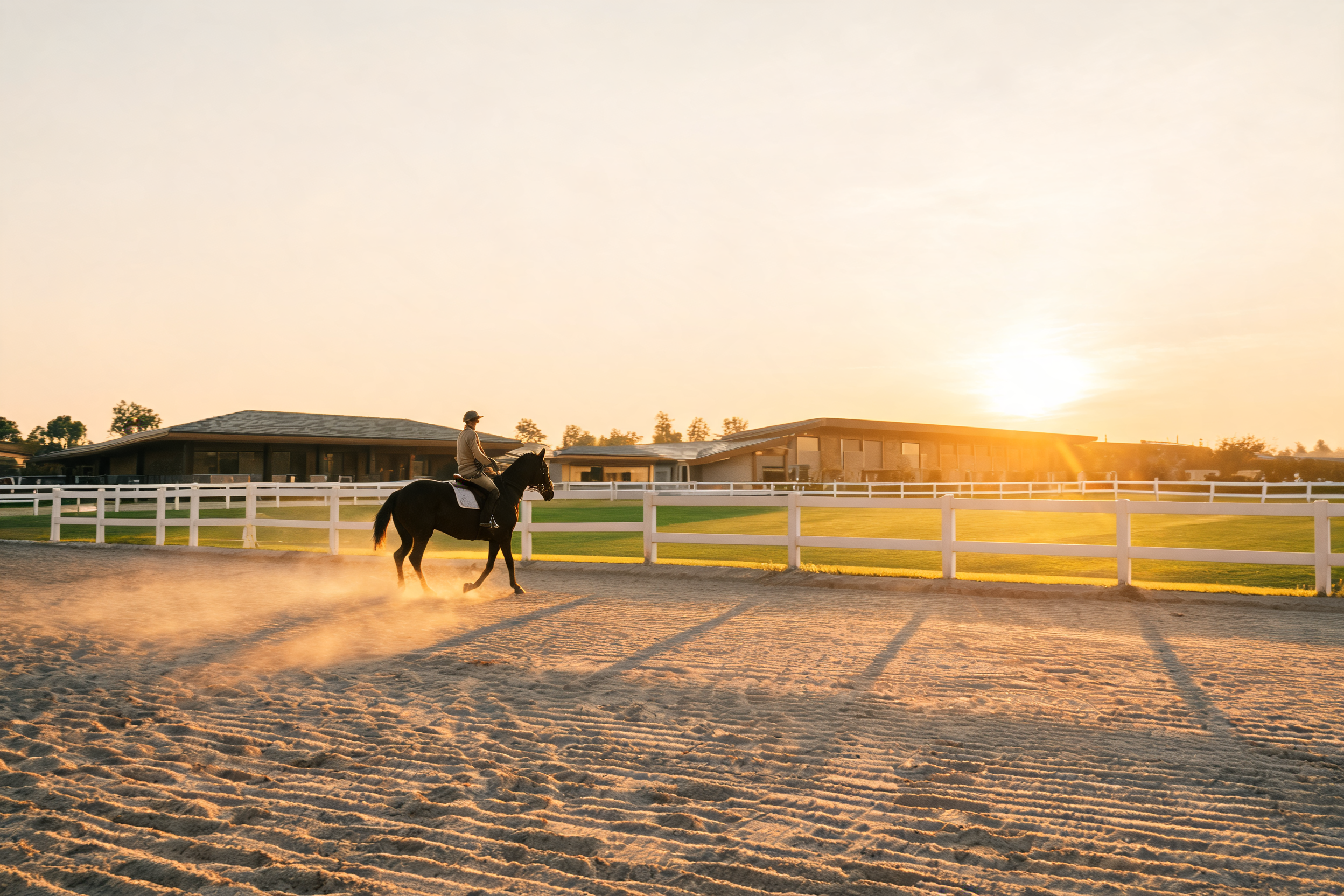
The horse occupies an unusual place in this part of the world, somewhere between heritage, sport and family. The Arabian breed carries centuries of Bedouin history, and the UAE has spent decades turning that inheritance into a serious international discipline. At Arabian Hills the ambition is smaller and, in a way, more difficult: to make riding an ordinary part of the week.
01
A tradition that is still working
Endurance racing and Arabian breeding remain genuinely woven into life here, not preserved behind glass. Faisal Al Rahmani, who runs the riding programme, grew up around horses and is wary of anything that treats the culture as a backdrop. "There is a version of this that is purely a photo, the horse as an accessory to a house," he said. "I have no interest in that. I want kids who can tack up their own pony and adults who ride badly at first and keep coming back."
The facilities are built for that range, from first lessons to experienced riders, with trails that carry the experience out into the wider landscape rather than keeping it penned in an arena. Al Rahmani talks about the horse as a teacher of patience, which sounds like a cliche until you watch a nervous beginner slowly stop fighting the animal and start listening to it.
“I want kids who can tack up their own pony and adults who ride badly at first and keep coming back.”
03
The care nobody sees
For every glamorous image of a rider at dawn, there are hours of unphotographed labour behind it, and Al Rahmani insists that the labour is the culture, not the decoration around it. His riders are expected to muck out, to learn a horse's temperament, to notice when an animal is off before it becomes a problem. The stables are designed around that daily rhythm, with feed, tack and veterinary space arranged so the routine is efficient rather than romantic.
"A horse does not care about your job title or your postcode," he said. "It needs feeding at the same time every day, and it will test you until you are consistent. That is a good discipline for a child, and honestly for an adult too." He is wary of the version of equestrian life sold purely as prestige. The heritage of the Arabian horse in this region, he argues, was always about partnership and endurance, not display, and a stable that forgets that becomes an expensive petting zoo.
“A horse does not care about your job title. It will test you until you are consistent.”
04
Riding out into the land
What sets a country estate apart from a city riding school is where the horse can take you. Trails thread out from the arenas into the wider landscape, so a lesson can graduate into a genuine ride across open ground rather than endless circuits of a sanded ring. Al Rahmani sees that as the reward that keeps people committed. "The arena teaches you to ride," he said. "The open trail is why you bother learning. The first time a nervous rider realises they can just keep going, out past the fences, something changes in them."
By Yusuf Karim, for the Arabian Hills Journal.