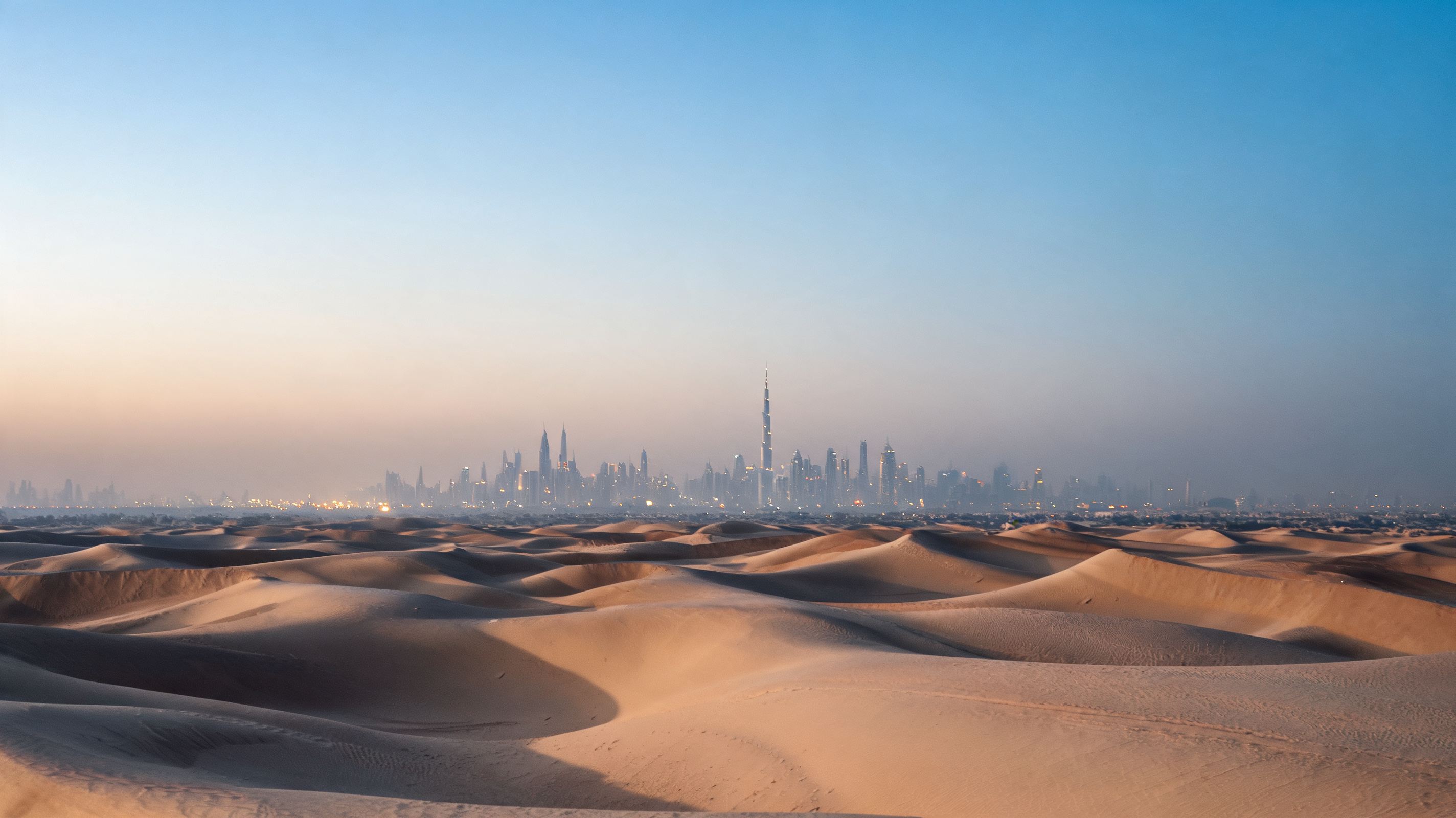
From the higher ground at Arabian Hills you can see the Dubai skyline at dusk, a thin silver comb on the horizon with the desert rolling out in front of it. The distance is the whole point. Close enough to reach the city in under an hour, far enough that the city stops setting the pace.
01
The commuter's arithmetic
Buyers on the edge of Dubai are always doing the same sum: how much space and quiet can I gain, and how much of my week will I spend on the road paying for it. The estate's position is pitched at people who have decided the trade is worth it, who want room and dark skies more than they want a ten-minute hop to the office.
Sami Haouari, the property analyst, has watched this calculation reshape the outer communities for years. "Every few years the map of what counts as too far gets redrawn," he said. "New roads shrink the distance, and places that felt remote suddenly feel reasonable. The people who buy at the edge early are betting on that pattern continuing, and historically in Dubai it has."
“Every few years the map of what counts as too far gets redrawn.”
02
A different clock
The shift from skyline to open land is not only about geography. It changes the texture of an ordinary day. Mornings are quieter, evenings are darker, and the constant background hum of a dense city fades to something you have to listen for. For some people that emptiness is unnerving. For the ones this place is built for, it is the entire reason they came.
03
The city you keep on a string
Nobody moving here is renouncing Dubai. That is the part the brochures for edge communities often overstate, the fantasy of total escape. In practice residents keep the city on a string, pulling it close for work, schools, flights and the occasional late dinner, then letting the distance do its work on the drive home. Haouari has seen enough of these buyers to distrust the clean-break narrative. "People do not want to leave Dubai," he said. "They want to be able to leave it at the end of the day. Those are very different products."
The infrastructure feeding the outer emirate has a habit of catching up with ambition, and that is the quiet bet underneath a place like this. New road links have repeatedly turned yesterday's remote plots into today's reasonable commute, and the whole map of desirability has kept sliding outward for two decades. Buyers at the edge are, in effect, wagering that the pattern holds one more time. Historically the ones who bought early and waited have been proven right more often than not, though Haouari is careful to note that a track record is not a promise.
“People do not want to leave Dubai. They want to be able to leave it at the end of the day.”
04
What the horizon gives back
There is a less financial argument too, and residents tend to reach for it first. Space at this scale changes how a family lives. Children have somewhere to roam, the sky at night actually has stars in it, and the day is set by light and heat rather than by traffic. That is hard to price and easy to underestimate from a show apartment in the city. It is also, for the people this estate is built for, the whole point of the drive.
By Omar Rethman, for the Arabian Hills Journal.