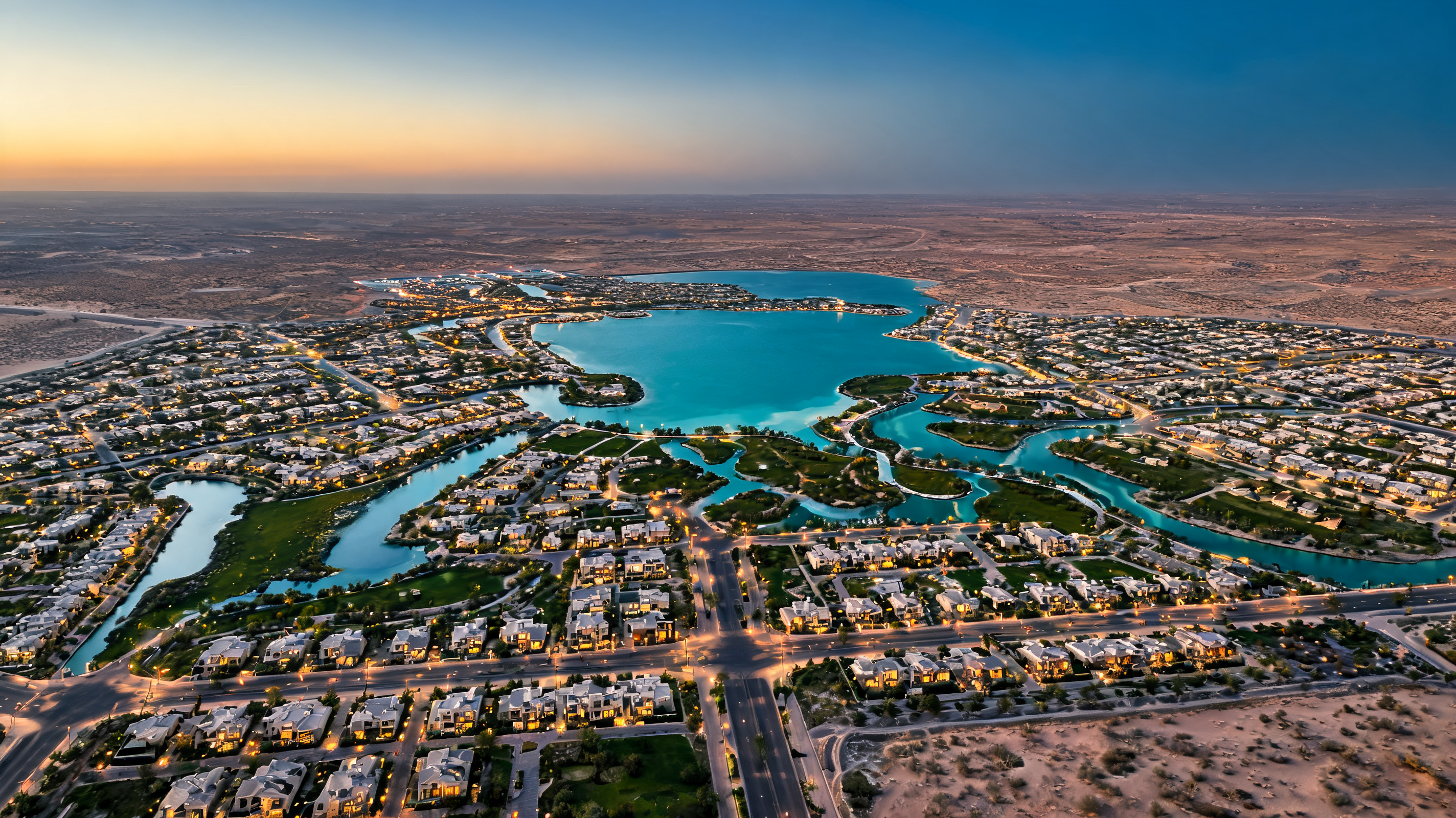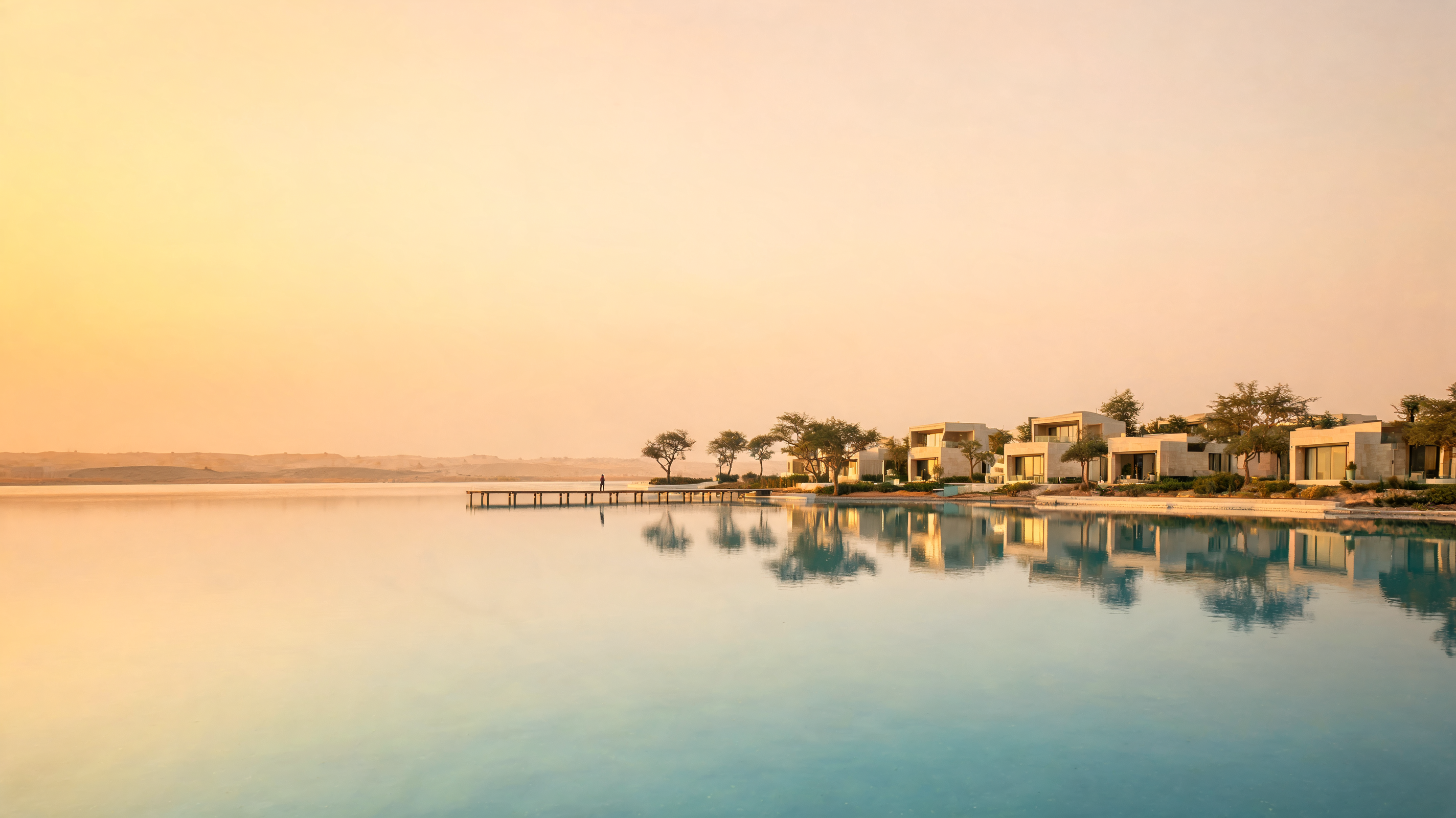
There is a particular hour, just before the light goes, when the lagoon at Arabian Hills turns the colour of weak tea and the whole place seems to exhale. It is easy to be cynical about engineered water in the desert. Standing at the edge of it, the cynicism is harder to hold onto.
01
Why water keeps appearing in the desert
Crystal lagoons have spread quickly through Gulf developments, and the reasons are not only aesthetic. A large volume of water buffers temperature swings, draws people outdoors in the cooler hours and gives a sprawling plan a fixed point to navigate by. Sami Haouari, a Dubai-based property analyst who has tracked lagoon communities since the first wave, puts it plainly.
"Buyers say they want a view. What they actually want is a reason to leave the house," he said. "Water does that in a way a lawn never will, especially here. The developments that treat the lagoon as a public spine tend to hold their value better than the ones that fence it off for a few premium plots." At Arabian Hills the water is deliberately continuous, threading between districts rather than pooling in one showpiece.
“Buyers say they want a view. What they actually want is a reason to leave the house.”
02
A shoreline with several tempers
Walk the full edge and the lagoon refuses to stay one thing. Near the promenade it is social, lined with cafes and swimming platforms. Further out it narrows into planted coves where the loudest sound is water against stone. This was a design decision, not an accident of budget. The landscape team wanted stretches that could hold a crowd on a Friday and stretches where a resident could sit alone at seven in the morning and feel unobserved.
Maintaining that range is its own discipline. Filtration, salinity and planting all have to work quietly in the background for the romance at the surface to survive. "The best compliment," one of the site engineers said, "is that nobody ever thinks about the machinery. They just think the water is clean and move on."
03
The cost nobody photographs
Water in a hot climate is never free, and the honest developments account for that rather than hoping buyers do not ask. The lagoon runs on a recirculation and filtration system rather than constant fresh supply, which is the standard the better crystal-lagoon operators have converged on across the Gulf over the past decade. Evaporation is the stubborn line in the ledger, and the planting along the quieter edges is there partly to shade the surface and slow it.
Haouari is blunt that the running cost is where these projects are quietly won or lost. "A lagoon looks glorious on launch day and becomes a service charge on the tenth anniversary," he said. "Buyers should be reading the maintenance model as carefully as the floor plan. The developments that survive are the ones that treated the water as a fifty-year commitment, not a marketing photograph." At Arabian Hills the team insists the operating budget was drawn before the shoreline was, which is the sort of claim that only the coming years can actually verify.
04
A horizon people can reach
For all the engineering, the argument the lagoon really makes is emotional. In a landscape defined by heat and distance, a large sheet of calm water rearranges how a day is spent. Residents drift toward it in the cool hours without being told to, and that gravitational pull is the point. A shared body of water gives a scattered plan a heart, somewhere the whole community ends up without anyone scheduling it.
By Omar Rethman, for the Arabian Hills Journal.